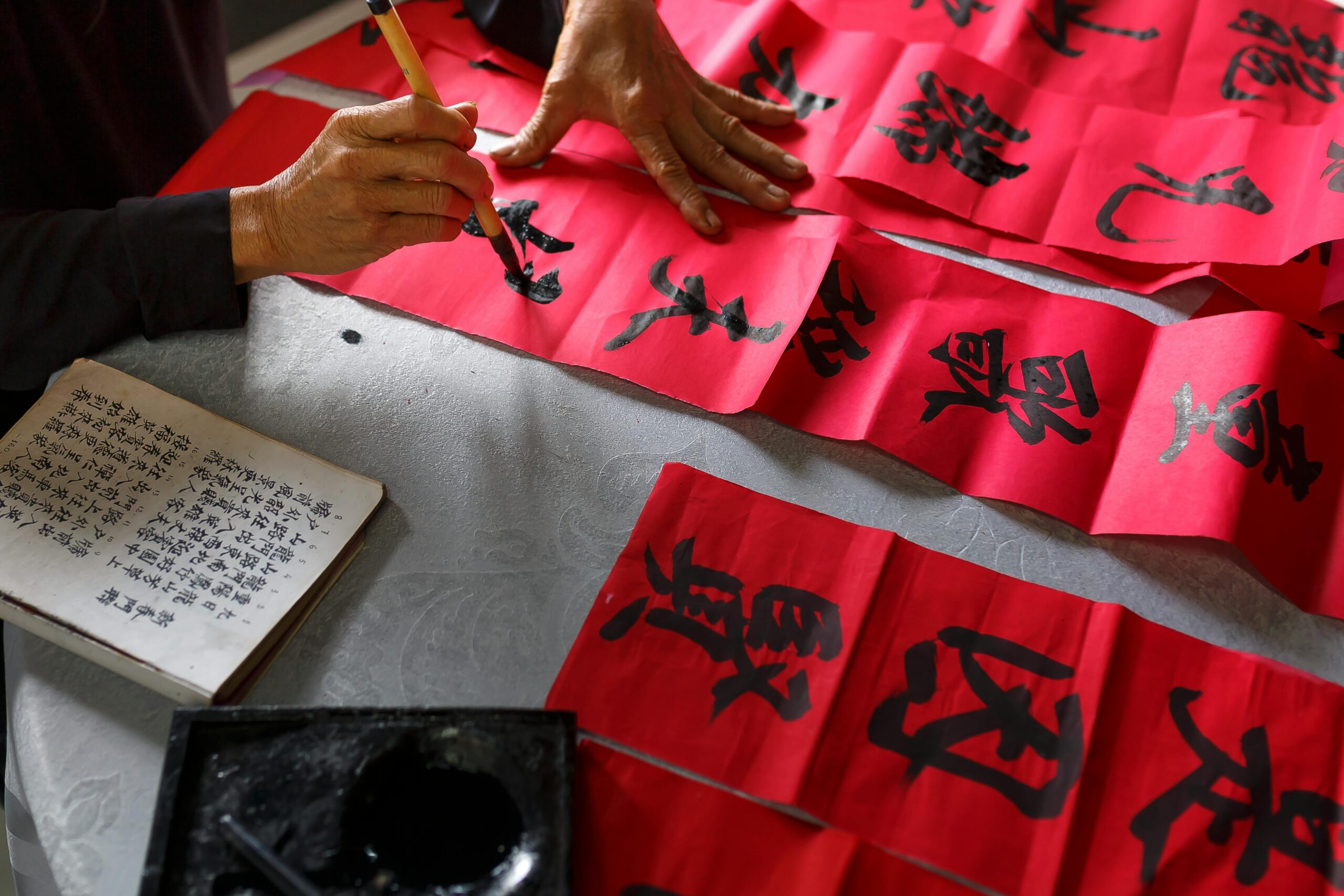
In March 2026, Chinese calligraphy (Shufa) is celebrated not merely as a method of writing, but as the “supreme art of the line.” While digital typography is instantaneous, calligraphy remains a slow, physical discipline that connects the artist’s internal energy (Qi) to the external world.
In the East Asian tradition, calligraphy is considered the highest of the “Four Arts,” outranking even painting and music because it reveals the character and moral fiber of the practitioner.
1. The “Four Treasures of the Study”
To practice Shufa in 2026 is to engage with materials that have remained largely unchanged for two millennia. These are known as the Wenfang Sibao.
- The Brush (Bi): Made from animal hair (rabbit, goat, or wolf). The magic of the Chinese brush lies in its tapered point, which allows for infinite variation in line thickness through pressure.
- The Ink (Mo): Traditionally made from pine soot and glue, pressed into solid sticks. The act of grinding the ink on a stone with water is a meditative prelude to the actual writing.
- The Paper (Zhi): Specifically Xuan paper (often called rice paper). It is highly absorbent, meaning the artist cannot “correct” a stroke; once the ink touches the paper, the movement is permanent.
- The Ink Stone (Yan): A carved stone used to grind the ink stick. High-quality antique ink stones are prized as “living” artifacts in 2026.
2. The Five Major Scripts
Chinese calligraphy evolved from rigid, pictographic origins into fluid, expressive forms.
| Script Name | Visual Style | Cultural Function |
| Seal Script (Zhuanshu) | Uniform, rounded, ancient. | Historically for official seals and inscriptions. |
| Clerical Script (Lishu) | Wide, flat, “silkworm head” strokes. | The “efficient” script of the Han Dynasty bureaucracy. |
| Regular Script (Kaishu) | Balanced, clear, and stable. | The foundation for beginners and modern printing. |
| Running Script (Xingshu) | Semi-cursive; fluid but legible. | The “everyday” art of the scholar; balanced speed. |
| Cursive Script (Caoshu) | Highly abstract; “Grass” script. | Pure emotional expression; strokes are connected. |
3. The Philosophy: Qi and Yin-Yang
In 2026, calligraphers focus heavily on the Neuro-aesthetic benefits of the craft.
- The Flow of Qi: The brush is seen as an extension of the body. The energy starts in the feet, moves through the core and shoulder, and is “breathed” onto the paper through the wrist.
- Yin and Yang: Every character is a balance of opposites—heavy vs. light, fast vs. slow, “wet” ink vs. “dry” brush (where the paper fibers show through).
- The “One-Stroke” Principle: In Cursive script, even if the brush leaves the paper, the intent must remain connected. This is known as “the stroke is broken but the idea flows.”
4. Technical Mastery: The “Eight Principles of Yong”
The character Yong (meaning “eternity”) is the quintessential teaching tool because it contains all eight foundational brush strokes.
- The Dot (Ce): Like a falling rock.
- The Horizontal (Le): Like a tight horse rein.
- The Vertical (Nu): Like a powerful crossbow.
- The Hook (Ti): A sudden, energetic kick.
- The Slant (Lue): A sweeping movement like combing hair.
5. Calligraphy in 2026: The “New Literati”
The biggest shift this year is the “Digital Detox” movement. Young professionals in Asia and beyond are turning to calligraphy as a form of “Active Meditation.”
- Virtual Reality Shufa: In 2026, VR headsets allow students to “walk through” famous historical scrolls, watching the 3D stroke-order of masters from the Tang Dynasty in mid-air.
- Sustainable Ink: There is a surge in “Botanical Inks” made from invasive plant species, combining ancient aesthetics with modern environmental activism.
- The “Slow Design” Trend: Luxury brands are increasingly using hand-calligraphed labels to signal “Human Craft” in an era of AI-generated content.
6. Summary: The Soul of the Line
Chinese calligraphy is the art of Leaving a Trace. In a world of “undo” buttons, the permanence of the ink on Xuan paper represents a commitment to the present moment.
Calligraphy Tip: If you’re starting out this month, focus on your Posture. Your back should be straight and your feet flat on the floor. In 2026, we understand that “Good Writing” is actually “Good Breathing” translated into ink.