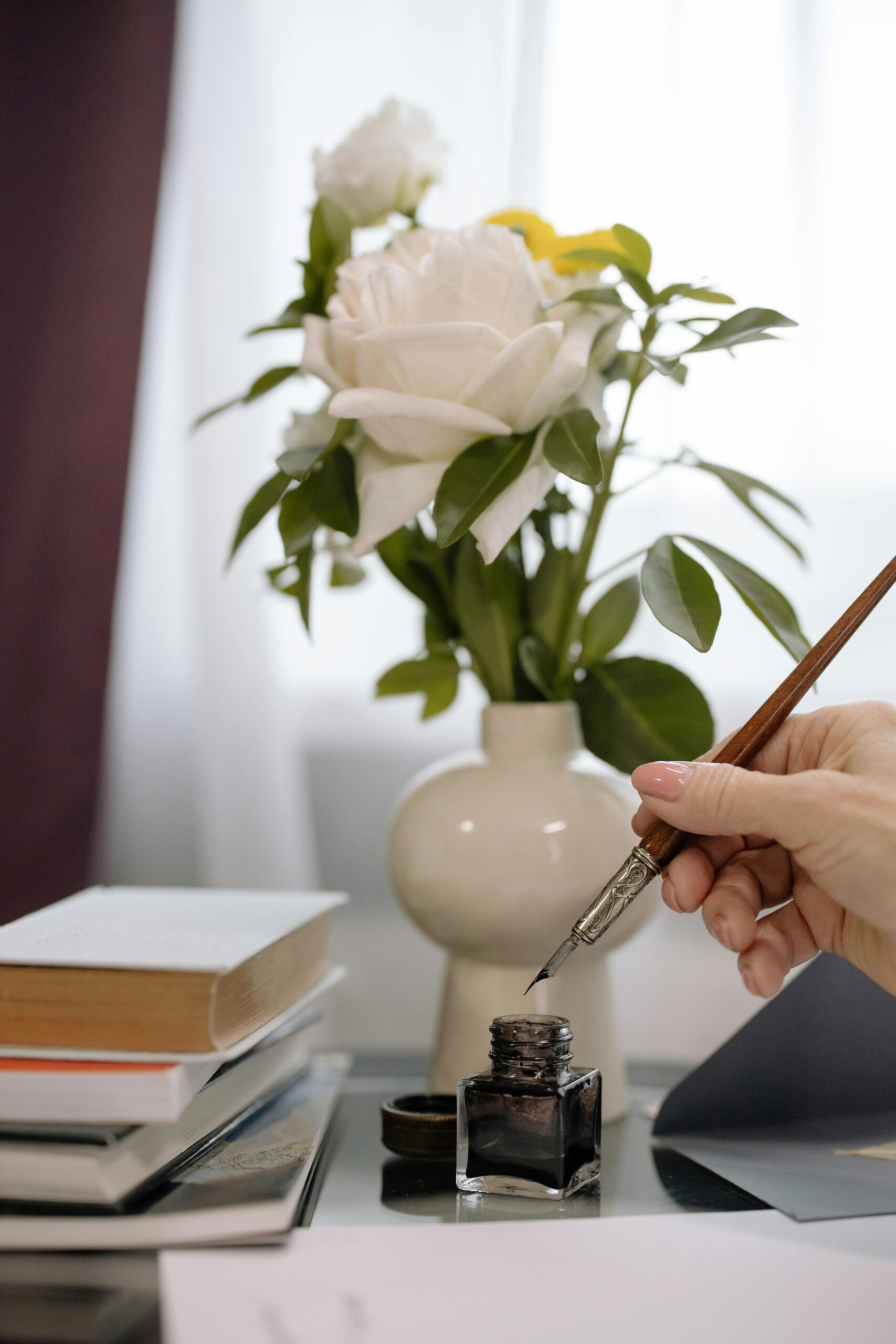
In March 2026, learning calligraphy at home has become a sophisticated “Analog Escape.” With high-definition video tutorials and the growth of the “Slow Art” movement, you can master the foundational strokes of any script—from Copperplate to Shodō—using a minimalist setup in your own living space.
This guide focuses on the Pointed Pen (Modern Calligraphy) and Brush Lettering, as these are the most accessible starting points for beginners this year.
Phase 1: The 2026 “Essential Starter Kit”
Before you touch pen to paper, you need the right tools. In 2026, we prioritize “High-Tooth” paper and “Low-Friction” nibs to reduce the initial frustration of “snagging.”
- The Pen: * For Pointed Pen: An Oblique Pen Holder (this helps you achieve the correct 55° slant without contorting your wrist).
- For Brush Lettering: A Small-Tip Brush Pen (e.g., Tombow Fudenosuke). Small tips are easier to control than large, “floppy” markers.
- The Nib (For Dip Pens): A Nikko G nib. It is stiff and chrome-plated, making it the most “forgiving” nib for beginners who tend to press too hard.
- The Paper: Rhodia Dot Pad or HP Premium 32lb. Standard printer paper will “bleed” and ruin your fine lines.
- The Ink: Sumitomo Sumi Ink or Higgins Eternal. These flow smoothly and dry with a beautiful, matte finish.
Phase 2: Posture and Setup (The “Internal” Work)
Calligraphy is a full-body activity. If your posture is wrong, your letters will be shaky.
- The “Feet-Flat” Rule: Sit with both feet flat on the floor. This stabilizes your core and prevents “shoulder-hiking.”
- The Paper Angle: Don’t keep the paper straight. Turn it about 30–45 degrees to the left (if you are right-handed). This aligns the slant of the letters with the natural movement of your arm.
- The “Bird-Grip”: Hold your pen holder lightly. If your knuckles are white, you are gripping too hard.
Phase 3: Mastering the 8 Basic Strokes
In 2026, we don’t start with the alphabet. We start with the Basic Strokes. Every lowercase letter in the Latin alphabet is just a combination of these eight shapes.
| Stroke | Movement | Mental Cue |
| Upstroke | Thin line moving upward. | “Feather-light touch.” |
| Downstroke | Thick line moving downward. | “Commit with pressure.” |
| Ovals | A counter-clockwise loop. | “The heart of the letter.” |
| Underturn | Down-thick, curve, up-thin (like a ‘u’). | “The swing.” |
| Overturn | Up-thin, curve, down-thick (like an ‘n’). | “The arch.” |
| Compound Curve | An ‘S’ shape combining over and under. | “The wave.” |
| Ascender Loop | The top of an ‘h’ or ‘l’. | “The reach.” |
| Descender Loop | The bottom of a ‘j’ or ‘g’. | “The anchor.” |
Phase 4: Your First 30-Day Practice Routine
Consistency beats intensity. In March 2026, the “Neuro-aesthetic” recommendation is 15 minutes a day rather than a 3-hour marathon once a week.
- Week 1: The “Pressure Test.” Spend 15 minutes a day just making thick downstrokes and thin upstrokes. Don’t worry about letters. Just feel the “bounce” of the nib.
- Week 2: The “Shape-Building.” Practice only Ovals and Compound Curves. These are the hardest shapes to master.
- Week 3: The “Alphabet Assembly.” Start connecting strokes to form letters. For example, an Underturn + an Oval = the letter ‘a’.
- Week 4: The “Rhythm Test.” Write one word (like “minimum” or “aluminum”) repeatedly. These words are great for practicing consistent spacing and slant.
Phase 5: Troubleshooting Common 2026 “Newbie” Issues
- Ink is “Blobbing”: You likely have a new nib with protective oil on it. Pro-Fix: Briefly pass the nib through a candle flame or wipe it with a bit of glass cleaner to “prime” it.
- The Pen is “Snagging”: You are likely pushing upward with too much pressure. Pro-Fix: Lighten your touch until the pen feels like it’s barely touching the paper on the upstroke.
- Shaky Lines: This is usually a sign of holding your breath. Pro-Fix: Exhale slowly as you pull a long downstroke.
Summary: The “Slow Art” Mindset
The goal of home calligraphy in 2026 is Mindfulness. Don’t judge your work against a computer font. Celebrate the “human-ness” of your lines.