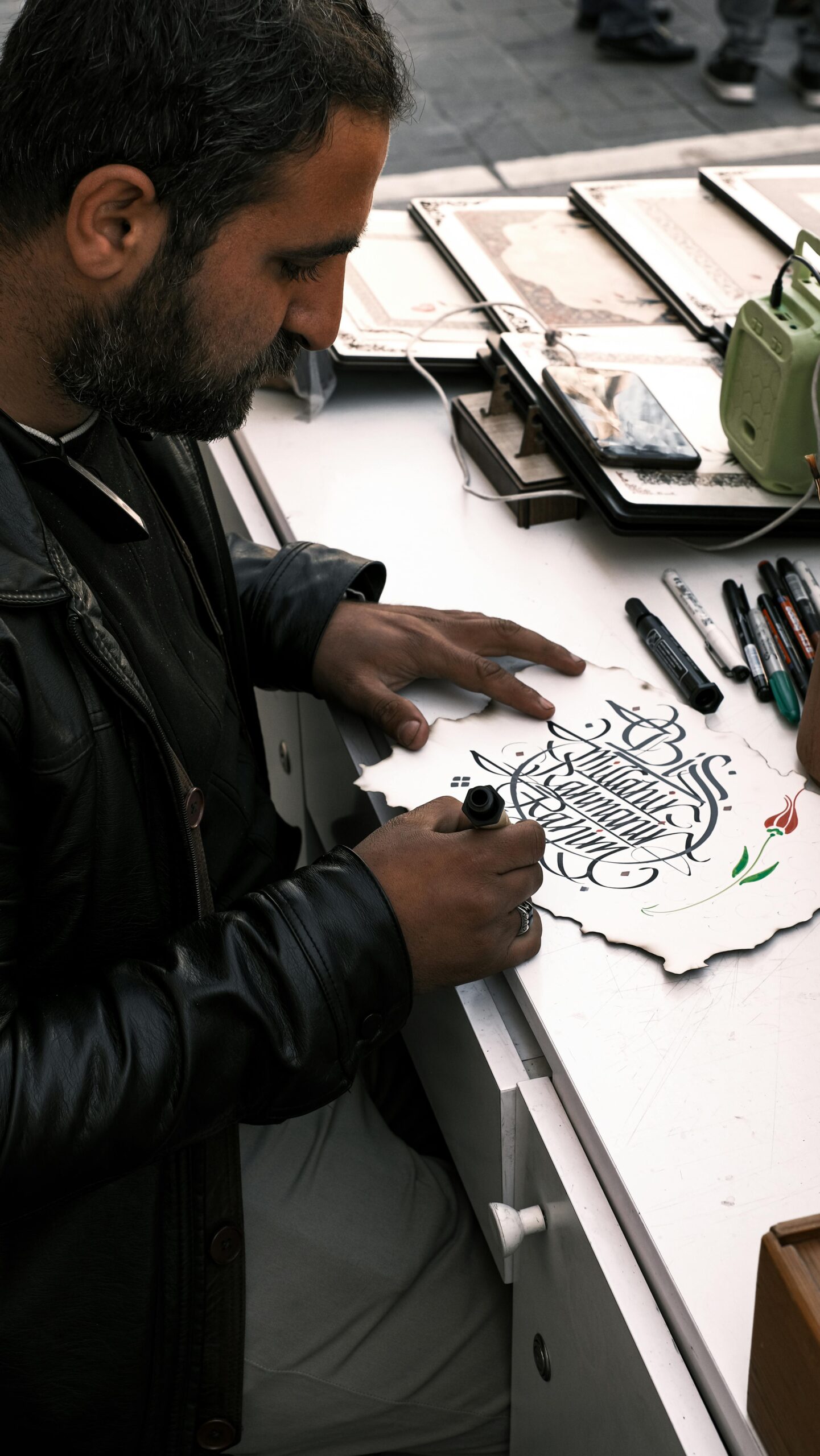
In March 2026, Islamic calligraphy is celebrated not merely as a decorative craft, but as “The Geometry of the Soul.” It represents the highest aesthetic achievement of the Islamic world, where the physical act of writing becomes a form of visual prayer. Because the depiction of sentient beings was traditionally discouraged in religious spaces, the “Word” became the primary vehicle for artistic and spiritual expression.
1. The Divine Connection: The Pen and the Word
In Islamic theology, the first thing created by God was the Qalam (the Pen). This gives the calligrapher a unique role as a “custodian of the sacred.”
- The Quranic Foundation: The primary drive behind the development of calligraphy was the desire to write the Quran in a style worthy of its divine origin.
- Adab (Etiquette): In 2026, traditional masters still teach that a calligrapher must be in a state of spiritual and physical cleanliness (Wudu) before picking up the pen. The purity of the writing is believed to be a reflection of the purity of the heart.
- The “Living” Script: Unlike static Western fonts, Islamic calligraphy is viewed as a “breathing” entity. The flow of the ink and the rhythm of the letters are intended to mimic the pulse of life and the infinite nature of the Divine.
2. The Science of Proportion: The Nukta System
Islamic calligraphy is one of the most mathematically rigorous art forms in existence. Established in the 10th century by Ibn Muqla, the system of “Proportioned Script” (al-khatt al-mansub) ensures that every letter is in perfect harmony with the universe.
- The Nukta (The Dot): The basic unit of measurement. It is a diamond-shaped mark made by pressing the nib of the reed pen (Qalam) onto the paper.
- The Alif: The first letter of the alphabet, the Alif, acts as the “standard.” Depending on the style, the Alif might be five, seven, or nine dots high. All other letters are then derived from the proportions of the Alif.
- The Circle: Every character must fit within an invisible circle whose diameter is the length of the Alif, symbolizing the unity and perfection of God.
3. Iconic Styles and Their Spiritual Moods
Each calligraphic style serves a specific spiritual or functional purpose:
| Style | Visual Character | Spiritual Context |
| Kufic | Angular, bold, and horizontal. | Stability, ancient authority, and “groundedness.” |
| Thuluth | Tall, interlocking, and majestic. | Grandeur and power; used for mosque domes and portals. |
| Naskh | Rounded, clear, and rhythmic. | Clarity and humility; the standard for reading the Quran. |
| Diwani | Highly cursive, soaring, and hidden. | Mystery and complexity; originally for royal secrets. |
4. Symbolic Forms: Zoomorphism and Hilye
Islamic calligraphy often moves beyond linear text into complex symbolic shapes:
- Zoomorphic Calligraphy: In 2026, this remains a popular high-art form where verses are woven into the shapes of lions (symbolizing courage), birds (symbolizing the soul), or ships (symbolizing salvation).
- The Tughra: Originally an imperial seal, these complex, cloud-like compositions represent the authority and “umbrella” of protection.
- The Hilye: A unique calligraphic “portrait” of the Prophet Muhammad. Since physical images are not used, his physical and moral qualities are described in a beautiful, circular calligraphic layout that serves as a focal point for meditation.
5. 2026 Practice: The “Digital Dhikr” Movement
The biggest cultural shift this year is the integration of ancient calligraphy with Neuro-aesthetic technology.
- Bio-Feedback Art: New installations in 2026 allow practitioners to wear sensors that track their heart rate and breathing. As they achieve a “meditative state,” a digital Qalam on a screen mirrors their inner calm through the smoothness of the calligraphic stroke.
- Sustainable Tools: Calligraphers are returning to Hand-Burnished Paper (Ahar), which is treated with egg whites and alum. This paper is “infinite”—because the ink sits on the surface, it can be wiped away and rewritten, symbolizing the human capacity for repentance and renewal.
6. Summary: The Silent Music
A common saying among masters in 2026 is that “Calligraphy is spiritual geometry, produced by a physical instrument.” It is the art of making the invisible (the breath and the thought) visible through ink.
Spiritual Insight: If you are observing a piece of calligraphy this month, don’t just look at the black ink. Look at the White Space (al-fada). In Islamic philosophy, the “emptiness” is as important as the “fullness,” representing the vastness of the Unseen.