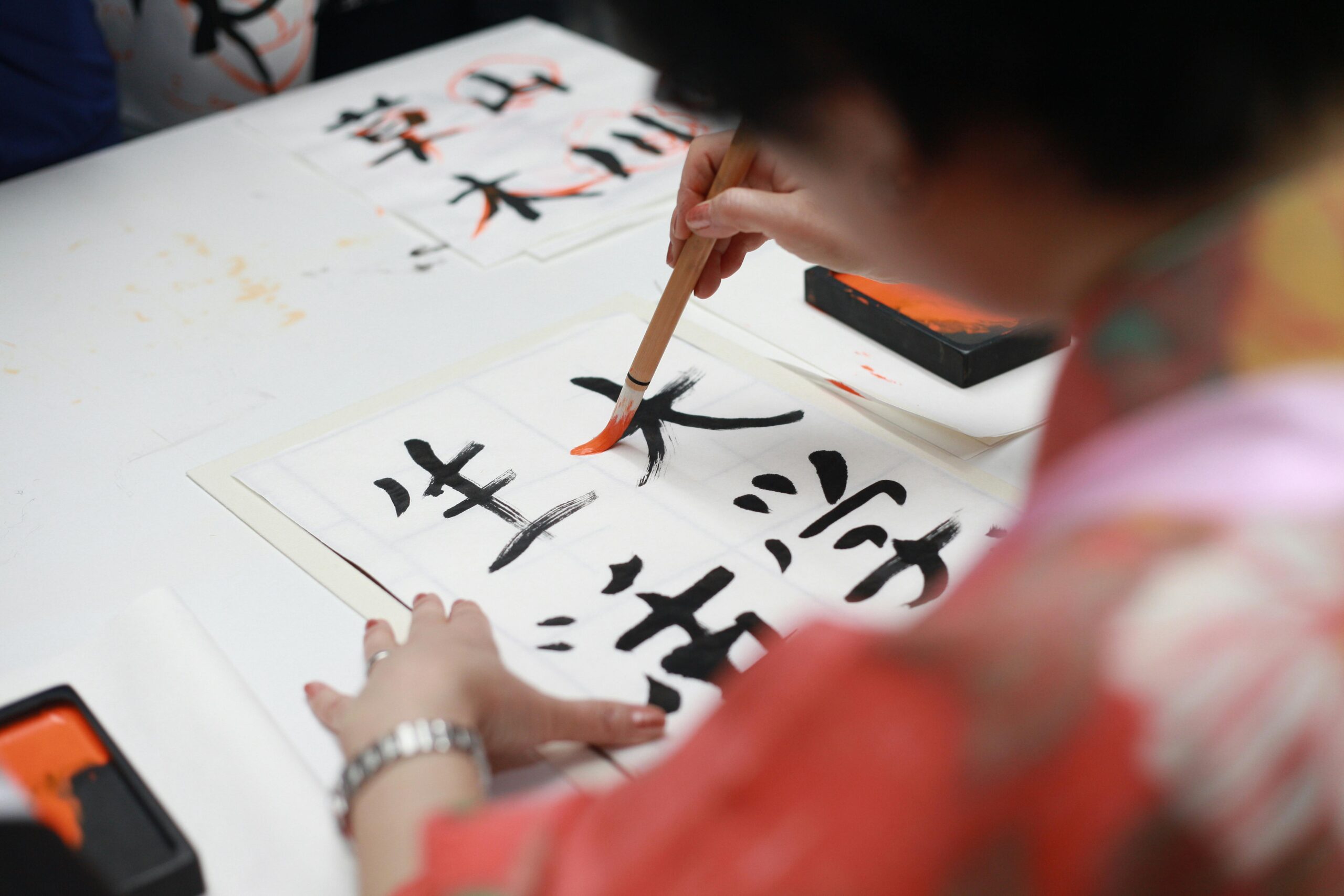
In March 2026, Western calligraphy is experiencing a significant “Analog Revival.” As digital interfaces become more sterile, the physical resistance of a metal nib on parchment has become a sought-after form of mindfulness and artistic distinction.
The history of Western calligraphy is essentially the history of the broad-edged tool. By changing the angle of the pen, scribes over two millennia created the three foundational pillars of the Latin script: Roman, Gothic, and Italic.
1. Roman Script: The Foundation of Proportions
The Roman script, specifically Roman Capitals (Inscriptional Capitals), is the “DNA” of almost every font you see on a screen today.
- The Tool: Originally carved with a chisel into stone, then adapted for the reed or quill.
- Key Characteristic: The Serif. These tiny “feet” at the end of strokes originated from the stone-carver’s chisel marks.
- The 2026 Aesthetic: Roman calligraphy is currently the gold standard for high-end luxury branding and architectural inscriptions. It requires a perfect 30° pen angle and immense patience.
- Humanist Minuscule: In the 15th century, Italian scholars “revived” a clearer, rounded version of Roman letters (based on Carolingian script), which became the basis for our modern “lower case.”
2. Gothic Script: The Architecture of the Page
Also known as Blackletter or Textura, Gothic script dominated Europe from the 12th to the 16th century. It is the visual equivalent of a Gothic cathedral: vertical, rhythmic, and dense.
- The Context: As universities grew, scribes needed to fit more words onto expensive parchment. They “compressed” the rounded Roman letters into tall, narrow columns.
- Key Characteristic: The “Picket Fence” Effect. The letters are so uniform and densely packed that the “counter” (the white space inside the letters) is the same width as the black stroke itself.
- Styles of Gothic:
- Textura: The most formal, rigid style used for Bibles (e.g., the Gutenberg Bible).
- Fraktur: A more “broken” and decorative German variant.
- Rotunda: A Southern European version that kept more of the Roman “roundness.”
3. Italic Script: The Speed of the Renaissance
Italic was born out of a need for efficiency. During the Renaissance, the Papal Chancery needed a script that was faster to write than the laborious Roman or Gothic styles.
- The Innovation: By slanting the letters and “branching” the strokes (connecting them without lifting the pen), scribes created a fluid, rhythmic flow.
- Key Characteristic: The Elliptical Shape. Unlike the circular Roman or the rectangular Gothic, Italic is based on an oval. It is written with a 45° pen angle and a slight 5° forward slant.
- Modern Use: In 2026, Italic is the most popular style for beginners. Its “cursive” nature makes it the bridge between formal calligraphy and artistic everyday handwriting.
4. Technical Comparison: The Pen Angle
| Script | Pen Angle | Visual Shape | Mood/Vibe |
| Roman | 30° | Circle / Square | Authoritative, Noble, Classic. |
| Gothic | 45° | Rectangle / Diamond | Dramatic, Medieval, Heavy. |
| Italic | 45° | Oval / Slanted | Fluid, Elegant, Intellectual. |
5. Calligraphy in 2026: The “Human Presence”
The biggest trend this year is “Expressive Calligraphy.” Rather than striving for the “perfect” mechanical look of a computer font, 2026 calligraphers are leaning into the “artifacts” of the craft:
- The Ink Pool: Allowing ink to pool at the end of a stroke to show the physical depth of the liquid.
- Dry-Brush Effects: Using a fast stroke to leave “streaks” of white paper through the black ink, signifying speed and human energy.
- Hybrid Scripts: Mixing Gothic “headers” with Italic bodies to create a high-contrast, modern layout.
Calligraphic Insight: In 2026, the mark of a master is not just the letterform, but the “Interlinear Space” (the white space between lines). A well-balanced page of calligraphy “breathes,” and that rhythm is what the human eye finds most relaxing in a high-tech world.