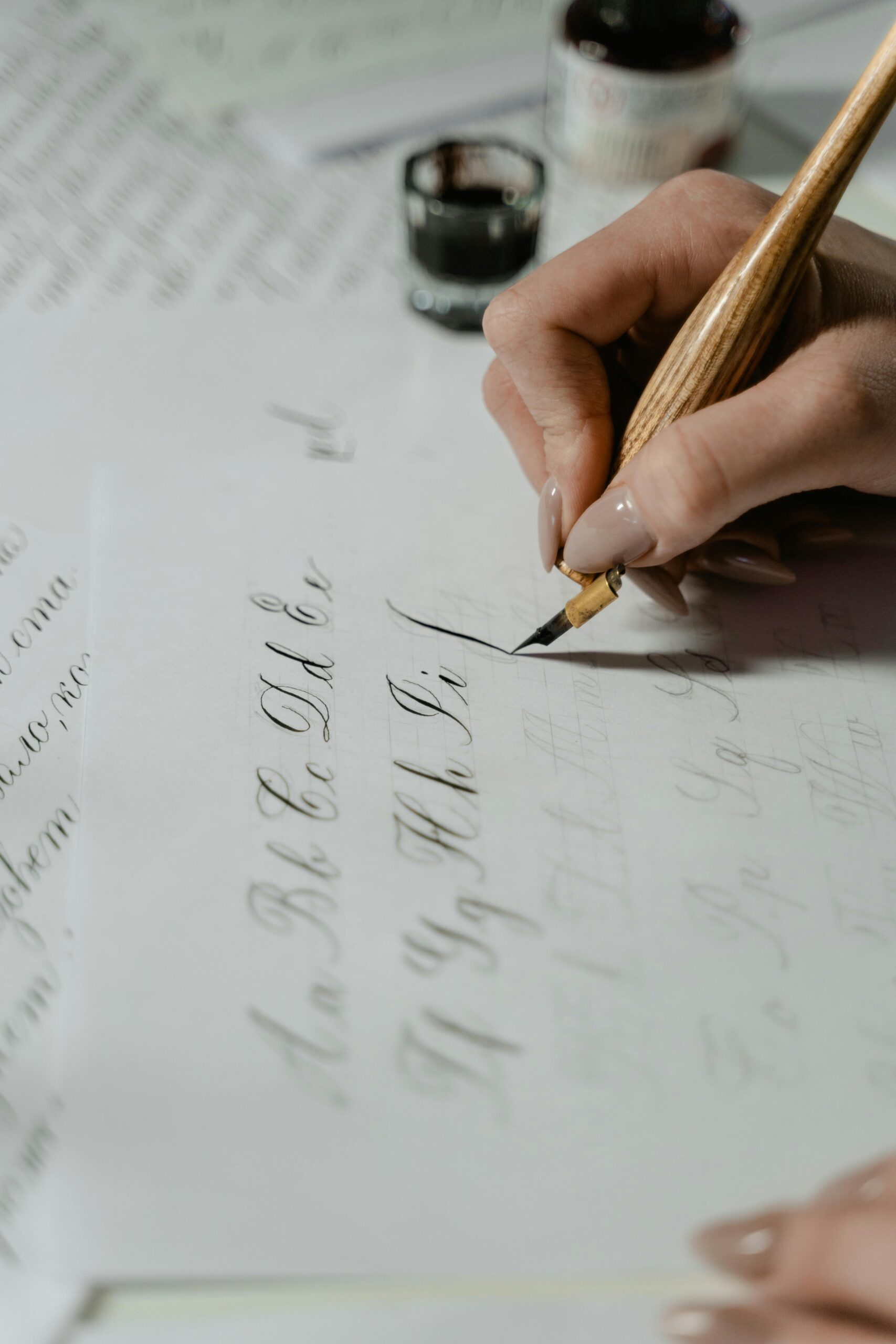
In March 2026, the choice between Brush Calligraphy and Pen Calligraphy is often viewed as a choice between two different “energies.” While both disciplines fall under the umbrella of calligraphy, they require fundamentally different physical mechanics, tools, and philosophical approaches.
The primary difference lies in how the thick and thin lines (the “swell”) are created.
1. The Mechanic of the Stroke
The most significant distinction is how the tool interacts with the writing surface.
- Brush Calligraphy (Pressure-Based): The brush is a flexible, tapered tool. Thick lines are created by pushing the brush down (spreading the bristles), and thin lines are created by lifting the brush up to use only the very tip. It is a highly “vertical” and 3-dimensional movement.
- Pen Calligraphy (Angle and Flex): * Broad-Edge Pens: Thick and thin lines are created by the angle of the flat nib. A horizontal stroke might be thin, while a diagonal stroke is thick.
- Pointed Pens: Like the brush, these use pressure, but the “swell” is limited by the physical split of the metal tines.
2. Tool Comparison: The “Feel” of the Craft
In 2026, calligraphers often switch between these tools depending on the “mood” of the project.
| Feature | Brush Calligraphy | Pen Calligraphy |
| Tool Type | Animal hair, synthetic bristles, or felt-tip markers. | Metal nibs (pointed or broad), quills, or fountain pens. |
| Ink Flow | High volume; prone to “pooling” and “dry-brush” textures. | Controlled, consistent flow through a metal reservoir. |
| Surface | Works best on absorbent or textured paper (Xuan, watercolor). | Requires smooth, “sized” paper to prevent the nib from snagging. |
| Precision | More organic, expressive, and “painterly.” | Highly precise, geometric, and structured. |
3. Philosophical Differences: Flow vs. Architecture
In the 2026 “Neuro-aesthetic” community, these two styles are used for different mental states.
- The “Flow” of the Brush: Brush calligraphy (like Shodō or modern brush lettering) is seen as “Liquid Motion.” Because the brush is so sensitive, it captures every micro-tremor of the hand. It is practiced for emotional release and “in-the-moment” expression.
- The “Architecture” of the Pen: Pen calligraphy (like Copperplate or Blackletter) is viewed as “Drawn Geometry.” It is a disciplined, rhythmic practice that focuses on historical accuracy, perfect ovals, and consistent slant. It is practiced for focus and structural clarity.
4. Learning Curve and Mastery
- Brush Calligraphy: Easier to start (especially with modern “Fudenosuke” brush pens) but much harder to master. Controlling the “bounce” of a soft brush requires significant muscle memory in the forearm and shoulder.
- Pen Calligraphy: Has a steeper initial learning curve due to the complexity of the tools (ink bottles, nib prep, and holders). However, the rigid nature of the metal nib provides more “training wheels” for maintaining consistent line widths.
5. Which One Should You Choose in 2026?
- Choose the Brush if: You want to create expressive wall art, modern wedding signage, or enjoy a “loose,” painterly style of meditation.
- Choose the Pen if: You enjoy historical manuscripts, formal invitations, or the tactile “scratch” of metal on paper.
Calligraphy Tip: In 2026, the “Pro Move” is to learn Pointed Pen basics first. The discipline required to control a metal nib will give you the “structural eye” needed to master the much more volatile brush later on.